Here's the latest chit chat fodder courtesy of my former customs broker.
$200 even less popular than $50
The Bank of Canada has withdrawn a proposal to introduce a $200 banknote after a survey of retailers revealed strong opposition. 59 per cent of those surveyed said they were opposed, with 40 per cent "strongly opposed." The central bank had been looking for a higher-denomination replacement for the $1000 banknote after it ceased to be printed in May, 2000, to help thwart money launderers and drug dealers who prefer large bills.
Oompa Loompas in disguise
Even before the recent security scares, the Conference Board in the U.S. found at the start of the summer that 40 per cent of consumers had no plans to take a vacation over the next six months, the lowest percentage recorded by the group in 28 years. About 25 per cent of American workers in the private sector do not get paid vacation time. Another 33 per cent will take only a seven-day vacation. Some companies are shutting down completely twice a year to ensure people stop working.
Better in the hand than on the wrist
Last year, the U.S. watch market saw a 4.9 per cent dip in sales. Rival electronic devices such as personal digital assistants and cellphones are the reason. Even sales of watches under US$50.00, rarely affected by overall market trends, are down.
Spray me guilty
Rich people can beef up their home security with the automatically activated SmartWater spray system. The technology, mounted on the walls or the ceiling, squirts the intrudes with a solution containing a unique forensic code that remains detectable on the skin and hair for weeks and on clothing indefinitely.
Pirates will become robbers
Films arrive in projection rooms as 10,000 feet of film printed as a copy of the original. Now, digital projection systems are the latest thing. The release copy of the movie is delivered on a hard drive, sporting 100 gigabytes of the latest Hollywood blockbuster, a digitally scanned copy of the master film print. Once put into place, the movie is simply unloaded to a server and is one button-push away from being digitally projected. The biggest advantage of digital projection is picture quality.
More discounts on naughty foods predicted
New research in the U.S. confirms that grocery circulars announcing the latest grocery specials are an effective means of connecting with consumers. Grocers spend some US$8-billion on feature ads each year, which amounts to two per cent of their sales. The research shows that at least 10 per cent of shoppers chose their store based on the week's ads and that shoppers were most influential when the ads promoted discounts on cereal, snack chips, pizza, cookies and hot dogs.
Unpopular paint has its day
An unpopular pigment used by 18th century artists could lead to more energy efficient, faster computers. Cobalt green, as it is known, has been tested by a US team who believe that, because of its magnetic properties, could be used in "spintronic" devices. Spintronics involves manipulating the magnetic properties of electron to do useful computational work. Cobalt green is a mixture of zinc oxide and cobalt and artists of the 18th century found it expensive and that it created relatively weak colours.
Nerds: 25 years in the making
This past August saw the 25th anniversary of the personal computer with the introduction of the IBM 5150. Costing $1,565, the 5150 had just 16K of memory, about enough for three or so e-mails nowadays. This machine which was developed by a team of 12 IBM engineers, altered the way business was done forever and sparked a revolution in home computing.
Spinach, carrot juice and now, cantaloupes
Cantaloupe melons have been identified as a common source of food poisoning. Researchers who studied records in Canada and the U.S. identified almost one large outbreak caused by cantaloupes every year over a 30-year period. It is believed that the problem lies in the rough skin of the cantaloupe being hard to clean meaning that bacteria on the outside can contaminate the flesh when it is cut open.
Shop until you drop
Shanghai has constructed a massive underground bunker complex capable of sheltering 200,000 people from a nuclear attack. The million-square-foot complex connects to shopping centres, office buildings, apartment buildings and the subway system via miles of tunnels. The complex has water, hydro, lighting, ventilation and protective doors and can support life for as long as two weeks.
Self-help is cheaper
A recent study shows that shoppers purchase impulse items such as snacks, candy, beverages and magazines 45.5 per cent less often when they use self-checkout than when they use a staffed checkout lane. The impact is greater for women, 50 per cent, versus a drop of 27.9 per cent for men. In 2005, consumers spent over US$111-billion on self-checkout transactions at retailers, up 35 per cent over the previous year. The average number of items in a self-checkout transaction is 6.7 with a value of $32.85.
Economic loss equals weight loss
The U.S. is warning India that bans on soft drinks like Coca Cola and Pepsi could blight its hopes of attracting American investment. Six Indian states have now announced partial or complete bans on soft drink sales in schools, colleges and hospitals after claims that the drinks contain harmful pesticides. Coke and Pepsi account for nearly 80 per cent of India's more than US$2-billion soft drink market
Impulse buying in seconds
The Polo Lauren Group is taking impulse shopping one step further with technology that allows passersby to purchase clothing they see in the windows of one of its New York stores by using a touch screen on the glass. Projected on the window of the store is a 67-inch image of items. Customers can purchase them by using a credit card swiper on the window.
Big Brother cares about your education
British university students are being monitored by a unique electronic tagging system designed to ensure that they attend lectures. About 1,000 undergraduates at the University of Glamorgan have been issued with key rings containing microchips that store each individual's name and other enrolment data. Every time he or she attends a lecture, the students press the key ring against a sensor that acts as an electronic receiver which records attendance.
Wednesday, November 01, 2006

Monday, October 30, 2006
My everyday routine
I have not blogged lately because there has been nothing interesting to report - just everyday life happening. But wait! It recently occurred to me that the minutiae of other people's everyday life can be verrrrrrry interesting!
A friend has an elderly uncle from Sweden coming for a visit and she asked what she should show him. My genuine suggestion was to take him on a tour of people's houses - preferably friends - because nothing fascinates me more than seeing domesticity and everyday life in foreign countries.
Luckily, you won't have to board a plane or a car to experience the magical weekday routine of an over-educated, under-employed, middle-class Canadian in Toronto.
I wake up at 8am to CFRB 1010 radio. This allows me to ease into wakefulness and hear what the weather is like. If I am very tired, I will easily integrate news stories into my dreams. I then spend about 20 minutes getting ready for work. This may or may not involve showering depending on how clean I feel.
I eat a high fibre cereal with 1% milk. Any cereal that offers less than 10g of fibre per serving is not worth eating. This high fibre content is necessary to make up for my otherwise low quality North American diet.
I walk 15 minutes to get to work at an institution of high learning. Not having to rely on public transportation or a car has reduced my stress levels like you wouldn't believe.
At work I walk a tight rope to avoid getting on my boss's bad side. The tasks vary so it's kind of like learning a new routine for the circus everyday. I am happy to report that like those 'Factory Worker Safety' billboards, it has been two months without a freakish encounter with my boss.
My job is part-time so I am done for the day at 1pm. I walk the 15 minutes home and usually check the mailbox. I am thrilled with whatever I get, whether it be free samples or my credit card bill. This is contrary to the heavy burden of responsibility that my parents used to warn me about adulthood. I love being an adult (or some version of one) and paying bills! Yah!
I eat lunch, which is usually left-overs from the night before, then I do one or more of the following: financial paperwork, housework, learn software, look for a full-time job, apply for a full-time job, exercise, chase after people who owe me money, or volunteer at a gallery.
At around 5pm, I start preparing dinner for Joe, who works full time and travels 90 minutes by public transit to get to and from work...but more on his daily routine in another blog entry. He usually arrives home around 6pm and then we eat whatever I have prepared. I usually like to avoid pre-packaged food because with the amount of preservatives the average North American consumes, noone will ever fear death again.
After eating and cleaning up, Joe and I swap time between the TV, the Internet and going for a walk. When it comes to TV, we do not have cable. We usually watch shows through the equivalent of an on-screen snow storm - a testament to our desperation for mindless entertainment. Sometimes, we'll even watch programming in languages we don't understand simply because the picture is clear and our eyes are not watering.
Our evening walks usually take place in commerical areas and malls as opposed to a scenic park. Joe and I look at things we cannot buy and talk about products - for ourselves and for others. It's like a two hour infomercial but with health benefits.
We start getting ready for bed around 11pm and are usually in bed by midnight.
Of course, there are variations to my daily routine, but this is pretty much it. Looking over my day, I'm ashamed at how idyllic it looks. Nowadays, it's a badge of honour to be stressed out, caffeine-addicted and have an agenda jam packed with meetings and events. I am currently looking to rejoin my jittery colleauges so perhaps, one day, this blog entry might become as quaint to me as it is to my friend's elderly Swedish uncle.
Please tell me your daily routine. Believe me, I'm fascinated!
A friend has an elderly uncle from Sweden coming for a visit and she asked what she should show him. My genuine suggestion was to take him on a tour of people's houses - preferably friends - because nothing fascinates me more than seeing domesticity and everyday life in foreign countries.
Luckily, you won't have to board a plane or a car to experience the magical weekday routine of an over-educated, under-employed, middle-class Canadian in Toronto.
I wake up at 8am to CFRB 1010 radio. This allows me to ease into wakefulness and hear what the weather is like. If I am very tired, I will easily integrate news stories into my dreams. I then spend about 20 minutes getting ready for work. This may or may not involve showering depending on how clean I feel.
I eat a high fibre cereal with 1% milk. Any cereal that offers less than 10g of fibre per serving is not worth eating. This high fibre content is necessary to make up for my otherwise low quality North American diet.
I walk 15 minutes to get to work at an institution of high learning. Not having to rely on public transportation or a car has reduced my stress levels like you wouldn't believe.
At work I walk a tight rope to avoid getting on my boss's bad side. The tasks vary so it's kind of like learning a new routine for the circus everyday. I am happy to report that like those 'Factory Worker Safety' billboards, it has been two months without a freakish encounter with my boss.
My job is part-time so I am done for the day at 1pm. I walk the 15 minutes home and usually check the mailbox. I am thrilled with whatever I get, whether it be free samples or my credit card bill. This is contrary to the heavy burden of responsibility that my parents used to warn me about adulthood. I love being an adult (or some version of one) and paying bills! Yah!
I eat lunch, which is usually left-overs from the night before, then I do one or more of the following: financial paperwork, housework, learn software, look for a full-time job, apply for a full-time job, exercise, chase after people who owe me money, or volunteer at a gallery.
At around 5pm, I start preparing dinner for Joe, who works full time and travels 90 minutes by public transit to get to and from work...but more on his daily routine in another blog entry. He usually arrives home around 6pm and then we eat whatever I have prepared. I usually like to avoid pre-packaged food because with the amount of preservatives the average North American consumes, noone will ever fear death again.
After eating and cleaning up, Joe and I swap time between the TV, the Internet and going for a walk. When it comes to TV, we do not have cable. We usually watch shows through the equivalent of an on-screen snow storm - a testament to our desperation for mindless entertainment. Sometimes, we'll even watch programming in languages we don't understand simply because the picture is clear and our eyes are not watering.
Our evening walks usually take place in commerical areas and malls as opposed to a scenic park. Joe and I look at things we cannot buy and talk about products - for ourselves and for others. It's like a two hour infomercial but with health benefits.
We start getting ready for bed around 11pm and are usually in bed by midnight.
Of course, there are variations to my daily routine, but this is pretty much it. Looking over my day, I'm ashamed at how idyllic it looks. Nowadays, it's a badge of honour to be stressed out, caffeine-addicted and have an agenda jam packed with meetings and events. I am currently looking to rejoin my jittery colleauges so perhaps, one day, this blog entry might become as quaint to me as it is to my friend's elderly Swedish uncle.
Please tell me your daily routine. Believe me, I'm fascinated!
Sunday, October 15, 2006
Good news! No one died
The 2006 Toronto Marathon took place today and no runner from Oakville or anywhere else died. It seems that the Toronto Waterfront Marathon already fulfilled the marathon body count for the year.
I ran the Half-Marathon and found it thoroughly enjoyable but could see why the Toronto Marathon is the neglected, plain sibling to the Toronto Waterfront Marathon.
1. The date - The Toronto Marathon usually takes place in mid-October whereas the Waterfront Marathon happens in late September. In a mere three weeks, the weather in Toronto goes from pleasantly nippy to uncomfortably cold. Last year's Toronto Marathon took place in freezing rain. It was unpleasant to say the least.
2. The location - Running through the city is usually my preferred route while training so it is arguable to say that the Waterfront Marathon is more scenic than the Toronto Marathon. However, without a doubt, the Waterfront Marathon is a faster course than the Toronto Marathon. Sure, portions of the Toronto Marathon go downhill, but these are usually accompanied by uphill portions. Plus, the last four kilometers of the course are definitely on an incline - not good after 38 kilometers of pain.
3. The crowds - There are less spectators along the route for the Toronto Marathon than the Waterfront Marathon. I think the reasons are related to #1: who wants to sit outdoors in freezing temperatures unless there are entertaining floats and a jolly fat man throwing candy canes at you?
4. The numbers - We stuck around to watch the front-runners of the marathon come in and were underwhelmed. Watching the first and second place runners race by, I had my suspicions that the Waterfront Marathon winners were faster. Numbers support this; the Waterfront Marathon winner finished in 2:10:15 whereas the Toronto Marathon winner finished in 2:34:10. The Waterfront Marathon first place prize is $15,000 whereas the Toronto Marathon provides its winner with a nice timepiece and merchandise. I guess you get what you pay for.
On the plus side, the Toronto Marathon had a strange SpongeBob Squarepants tie-in this year. SpongeBob sponges were provided to runners on course, volunteers wore SpongeBob t-shirts and caps, and SpongeBob himself showed up at the Start and Finish lines.
I think the Toronto Marathon organizers are on to something. If you can't beat a competing event at their own game, go wacky. The Toronto Marathon already offers a Team Relay option that makes the Marathon a fun party with your friends but how about tackling each of the above problems in the same spirit:
1. Push the date of the event even further back to coincide with Halloween and encourage runners to don costumes. I ran with three men in tutus for most of the Half-Marathon and spectators and runners alike enjoyed how pretty they were.
2. Bands or DJs should be posted at the top of every hill to provide musical accompaniment for the climb then the exhilirating drop. Or maybe a drill coach screaming on a bull horn at the top of the worst hill, Hoggs Hollow. Instead of ignoring the hills on the course, they should be highlighted and made into fun events in themselves.
3. #1 and #2 should solve #3. Who doesn't enjoy costumes and screaming?
4. A timepiece prize is respectable but what would be more fun is the runner's weight in ham, or a $1000 shopping spree at the Running Room with a 10 minute time limit, or a pasta party for 50 of the winner's closest friends. Again, if you can't cough up the cash, go wacky.
Another running season ends and now comes another tough winter of maintenance. I welcome anyone who wants to join me on runs in the dark - costumes optional.
I ran the Half-Marathon and found it thoroughly enjoyable but could see why the Toronto Marathon is the neglected, plain sibling to the Toronto Waterfront Marathon.
1. The date - The Toronto Marathon usually takes place in mid-October whereas the Waterfront Marathon happens in late September. In a mere three weeks, the weather in Toronto goes from pleasantly nippy to uncomfortably cold. Last year's Toronto Marathon took place in freezing rain. It was unpleasant to say the least.
2. The location - Running through the city is usually my preferred route while training so it is arguable to say that the Waterfront Marathon is more scenic than the Toronto Marathon. However, without a doubt, the Waterfront Marathon is a faster course than the Toronto Marathon. Sure, portions of the Toronto Marathon go downhill, but these are usually accompanied by uphill portions. Plus, the last four kilometers of the course are definitely on an incline - not good after 38 kilometers of pain.
3. The crowds - There are less spectators along the route for the Toronto Marathon than the Waterfront Marathon. I think the reasons are related to #1: who wants to sit outdoors in freezing temperatures unless there are entertaining floats and a jolly fat man throwing candy canes at you?
4. The numbers - We stuck around to watch the front-runners of the marathon come in and were underwhelmed. Watching the first and second place runners race by, I had my suspicions that the Waterfront Marathon winners were faster. Numbers support this; the Waterfront Marathon winner finished in 2:10:15 whereas the Toronto Marathon winner finished in 2:34:10. The Waterfront Marathon first place prize is $15,000 whereas the Toronto Marathon provides its winner with a nice timepiece and merchandise. I guess you get what you pay for.
On the plus side, the Toronto Marathon had a strange SpongeBob Squarepants tie-in this year. SpongeBob sponges were provided to runners on course, volunteers wore SpongeBob t-shirts and caps, and SpongeBob himself showed up at the Start and Finish lines.
I think the Toronto Marathon organizers are on to something. If you can't beat a competing event at their own game, go wacky. The Toronto Marathon already offers a Team Relay option that makes the Marathon a fun party with your friends but how about tackling each of the above problems in the same spirit:
1. Push the date of the event even further back to coincide with Halloween and encourage runners to don costumes. I ran with three men in tutus for most of the Half-Marathon and spectators and runners alike enjoyed how pretty they were.
2. Bands or DJs should be posted at the top of every hill to provide musical accompaniment for the climb then the exhilirating drop. Or maybe a drill coach screaming on a bull horn at the top of the worst hill, Hoggs Hollow. Instead of ignoring the hills on the course, they should be highlighted and made into fun events in themselves.
3. #1 and #2 should solve #3. Who doesn't enjoy costumes and screaming?
4. A timepiece prize is respectable but what would be more fun is the runner's weight in ham, or a $1000 shopping spree at the Running Room with a 10 minute time limit, or a pasta party for 50 of the winner's closest friends. Again, if you can't cough up the cash, go wacky.
Another running season ends and now comes another tough winter of maintenance. I welcome anyone who wants to join me on runs in the dark - costumes optional.
Friday, October 06, 2006
The colour of crass commercialism
 For a while, I have become increasingly disturbed by the commercialization of the Breast Cancer Pink Ribbon campaign. Instinctively, I shied away from the pink products because they reeked of Stepford Wife. I was going to work out my more reasonable objections in a blog entry before Samantha King beat me to it with an eloquent article in The Toronto Star.
Excerpts from the article:
I couldn't have said it better myself.The cheerfulness and consumer-oriented character of breast cancer survivor culture can be enormously alienating to women who do not have the financial means or networks of social support to participate in it, not to mention unintentionally working to denigrate those who have "failed" to survive.
This particular problem has been magnified considerably by corporate interest in the disease. [...] Sickness and death do not sell, but images of survivors who are uniformly youthful, ultrafeminine, immaculately groomed, radiant with health, and seemingly at peace with the world, do.
The effect of breast cancer marketing campaigns is to erase from public consciousness the fact that incidence rates remain stubbornly high and newly diagnosed women face essentially the same options — surgery, radiation, chemotherapy — that they did 40 years ago.
That mortality rates have been declining slightly since the early 1990s offers little comfort to the estimated 22,000 Canadian women who will be diagnosed with breast cancer in 2006.
People often point to the good work that breast cancer campaigns perform in raising "awareness" and argue that regardless of the accompanying messages, pink ribbon products and 5k runs raise large amounts of money for a good cause.
But this position raises its own set of questions: What exactly are we being asked to gain awareness of? And how is the money being spent? For those campaigns and events that venture into specifics, awareness usually means preaching the benefits of early detection through mammograms.
Although [mammograms] might prompt people to discover if they already have breast cancer, this selective brand of awareness asks individuals to take personal
responsibility for fending off the disease, while ignoring tougher questions related to what might be done to prevent it in the first place.
Monday, October 02, 2006
Nuit Blanche Part Quartre: More than words
Okay, words are not enough. See for yourself.
I'm starting to look like a Nuit Blanche stalker. This is the final installment, I swear.
I'm starting to look like a Nuit Blanche stalker. This is the final installment, I swear.
Sunday, October 01, 2006
Nuit Blanche Part Trois!
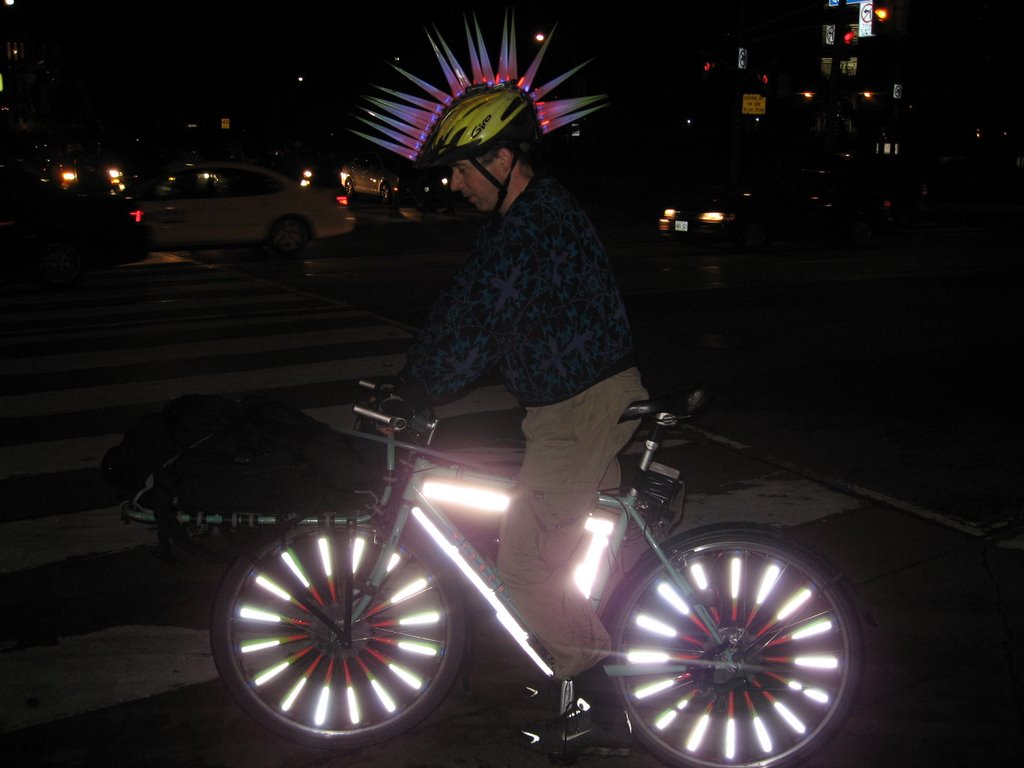 From the impressive turnout throughout the night, I would say that Nuit Blanche was a success. In spite of the chilly, wet weather, large masses of people clutching Nuit Blanche booklets were seen roaming all over the downtown core, even as I bowed out shortly after 1am.
Complementing the official events were entertainers with an entrepreneurial spirit. Like the guys who cruise in their convertibles through the club district during the summer, the neon cyclist seen above was a creative type taking advantage of a ready audience. While stopped at a red light, I ran up to him and asked if I could take his photo. He didn't reply but instead, reached down to switch on additional lighting on the frame of his bike for an even more photogenic experience. Also taking advantage of a mob ready to be entertained was Zanta, profiled by Flocons. The Toronto street character posed for photographs with enthusiastic fans and, contrary to appearances, was coherent enough to direct me to turn my flash on when my camera failed to capture his pose. I followed his advice and got the image on the left.
I saw much more than I have listed in my blog but not as much as I had intended. For instance, I completely missed Zone C, which featured the Queen West galleries. My only hope is that Nuit Blanche will become an annual event and return next year. And knowing what I know now, I will prepare by sleeping all day Saturday, wearing hiking boots, and sustain myself on a steady supply of Red Bull from a hydration backpack. Oh caffeine, how much I needed thee!
Nuit Blanche Part Deux!
My previous blog entry, "Nuit Blanche Madness!" was written at 3am and featured only the Nuit Blanche exhibits strong enough to overcome the incoherent mess that I become at that time. And now, the rest of the story.
The artistic events that garnered the most reaction from visitors were usually the ones that interacted with the public on a large scale and/or worked with the environment it was in.
The artistic events that garnered the most reaction from visitors were usually the ones that interacted with the public on a large scale and/or worked with the environment it was in.
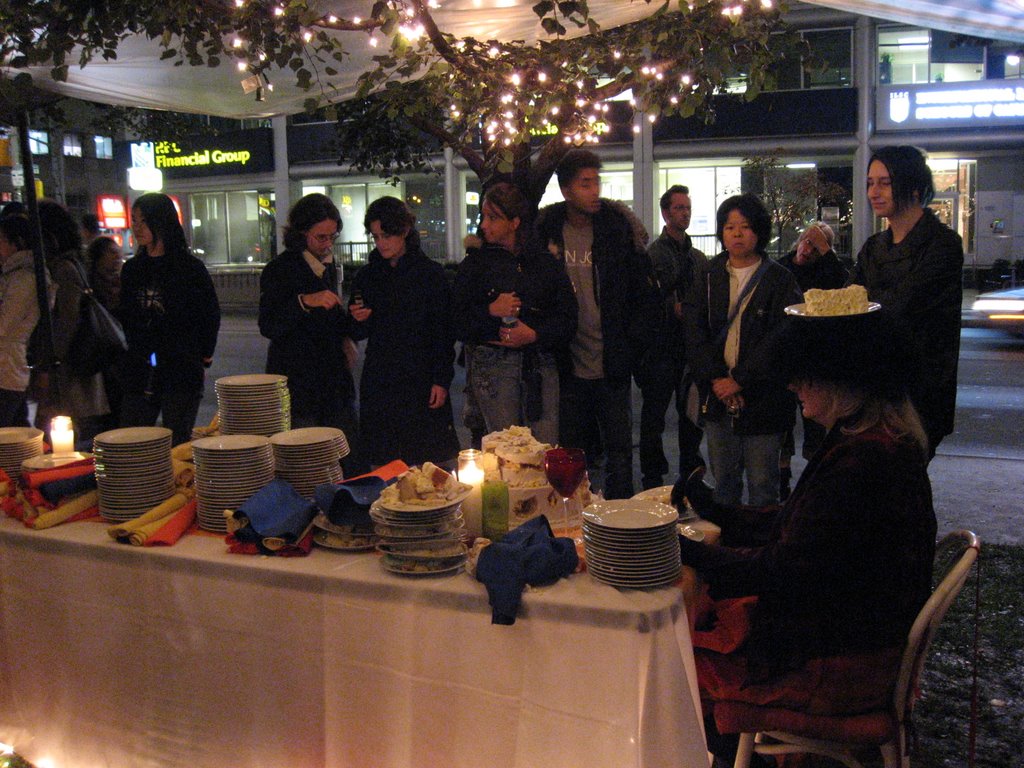
 In Pursuit of Happiness by Tanya Mars did none of the above. Spectators looked on in confusion as two lethargic women, sitting at opposite ends of a long table, ate some elaborate looking cake. On the table was more cake, piles of plates and cutlery wrapped in napkins. It was supposed to be "an opulent all-night party [...] so decadent as to incite debauchery" but it just became a puzzling and boring tableau. It would have been nice if all the guests who had come to visit the party were actually invited to have some cake or if the women stayed in character while engaging the public.
Boredom turned to obnoxiousness as members of the public loudly asked why the women looked so grumpy and when they could have some cake, too. No response from either of the women except to place a plate of cake onto of their fancy hats. Weak. Model for a Public Space by Adrian Blackwell was made specifically to engage the public and facilitate conversation. In the impressive circular, ramping amphitheatre, guest speakers were scheduled throughout the night to help along the discussions. The artist himself was the featured speaker when I arrived and he was speaking about the way urban environments, like the ones featured in Nuit Blanche, naturally bring about art and culture. It was a case of preaching to the converted since all who were present were pretty much urban art enthusiasts who would gladly support any initiative that fed their interests.
One dissenting voice did rear its head: a man objected to the idea that events like Nuit Blanche were widely accessible. He believed that initiatives for the public should be simple in order to reach the widest audience. The man was obviously looking for a fight but he did raise some valid points. Blackwell's reaction was to look blankly at the speaker then shrug his shoulders. Another member of the audience broke the awkward silence by taking one of the man's points out of context and turning it into a joke. The conversation then continued with everyone asking polite questions of Adrian Blackwell and the one dissenter walked off in a huff.
Even though I essentially agree with everything Blackwell proposed, there is no denying that his proposals are not appealing to a wide public - for instance, the 905 suburbs. And Blackwell's reaction to dissent didn't exactly facilitate public debate as the space was intended to do. Almost everyone in the audience was of a certain age, income and education bracket. And almost all nodded in agreement. The whole circle of 'yes men' turned me off. I was really looking forward to Position Yourself in a Network of Possibilities by Samuel Roy-Bois because it was supposed to be a recreation of the dance floor from the 1977 film, Saturday Night Fever.
It was a close enough facsimile but, when I arrived, noone was dancing on the floor. Everyone just watched as the floor lights pulsated to the beat of the free style jazz (!) being blasted from the speakers. Then some drunken frat boy had his girlfriend mount him before dancing an impressive one-legged, improvised jig. Without a doubt, it was entertaining but it also highlighted how ridiculously inaccessible Roy-Bois's choice of music was - especially after attending Ballroom Dancing (see previous blog), where the playing of music by the Pussy Cat Dolls created an unpretentious environment conducive to unreserved public interaction.
Blogger won't let me post any more photos here so on to the next posting!
Subscribe to:
Posts (Atom)